
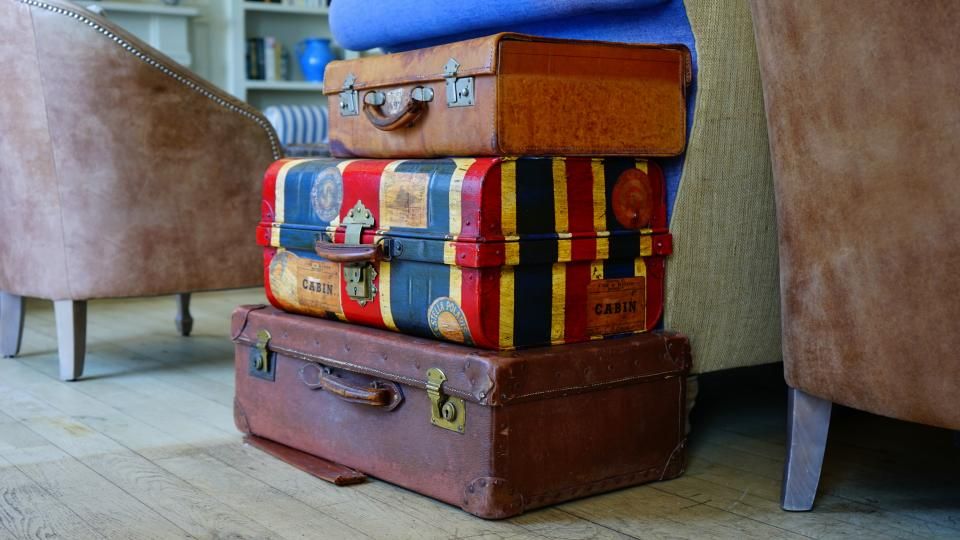
Few parts of flying today are as confusing — or as costly — as baggage fees. A $99 fare can swell to $250 once you pay for a checked bag and find out your "carry-on" doesn't fit the airline's sizer. Each airline sets its own rules, and the same airline treats different fare types differently. International norms don't match domestic ones, and gate agents have plenty of leeway to charge or waive fees on any given day. Here's what you need to know to avoid unpleasant surprises.
Carry-On vs. Checked: The Basics
Airlines split luggage into two broad groups, and knowing which is which decides what you'll pay.
Carry-on luggage is whatever you take into the cabin. Most US carriers permit one carry-on bag (a small suitcase for the overhead bin) plus one personal item (a backpack, purse or laptop bag for under the seat ahead). Carry-ons are usually free on most fares, but Basic Economy on United, American, Frontier and Spirit restricts them, so unless you pay, you're limited to a personal item.
Checked luggage is whatever goes in the hold. US airlines generally charge $35 to $50 for the first checked bag and $45 to $65 for the second on domestic flights. International long-haul fares often include one or two checked bags, depending on the airline and destination.
How Big and How Heavy Your Carry-On Can Be
The usual US domestic carry-on maximum is 22" x 14" x 9", wheels and handles included. Most airlines also set a 40-pound weight cap, although many don't actually weigh bags. Foreign carriers, and budget airlines above all, are tougher on both size and weight.
- Southwest — 24" x 16" x 10" (a little roomier than rivals), no weight limit
- United, American, Delta, Alaska — 22" x 14" x 9" carry-on, no weight limit on most fares
- JetBlue — 22" x 14" x 9" with no weight cap
- Frontier — 24" x 16" x 10", though most fares charge for a carry-on
- Spirit — 22" x 18" x 10" (Big Front Seat or Free Spirit fare); standard fares pay for a carry-on
- Ryanair, easyJet (European budget airlines) — smaller dimensions and active weighing; expect a 10kg/22lb limit on a free carry-on
- International long-haul — broadly similar to US norms, but confirm with your airline
If your bag is close to the limit, choose a soft-sided one — soft bags squeeze to fit where hard shells won't. Measure it with a tape measure or a phone measuring app before you leave for the airport, because gate-check fees can add $50 to $100 on top of your fare.
Domestic Checked Bag Fees, Airline by Airline
Checked bag charges have risen at every major US airline. For 2025, here's roughly what the first and second bags cost on standard fares.
- Southwest Airlines — two checked bags free (the only big US airline that still does this)
- Delta Air Lines — first bag $35, second bag $45
- American Airlines — first bag $35, second bag $45
- United Airlines — first bag $35, second bag $45
- Alaska Airlines — first bag $35, second bag $45
- JetBlue — $35-45 first bag (depending on fare type), $50-60 second
- Spirit and Frontier — $30-65+ depending on the fare bundle and when you pay
Paying at the airport costs more than paying online, so settle bag fees when you book or at online check-in to save $5 to $15 per bag. Co-branded cards from American, United, Delta, Alaska and JetBlue all include free checked bags, a perk worth $70 to $100 per round trip that can cover the annual fee in a single trip.
Checked Bags on International Flights
Long-haul international fares usually come with a more generous checked allowance, though the rules differ a lot by airline and route.
- Budget transatlantic airlines (Norse Atlantic, French bee, Play) — checked bags cost extra; confirm before you buy
- Most legacy international airlines (British Airways, Lufthansa, Air France, KLM, Emirates, Qatar) — one free checked bag in economy on transatlantic and intercontinental routes
- Latin American airlines (LATAM, Avianca, Copa) — usually one free bag internationally, fewer on domestic flights within the region
- Certain Asian and Middle Eastern airlines — two free checked bags (often Singapore, ANA, JAL)
International checked bags are generally capped at 50 pounds (23 kg) for the first bag and 70 pounds (32 kg) in premium cabins. Overweight charges run $100 to $400 per bag, on top of any regular bag fee, so check your luggage with a portable scale ($10) before you go.
What Counts as a Personal Item
Your personal item has to fit beneath the seat ahead of you. The typical maximum is about 18" x 14" x 8", but airlines seldom enforce it closely unless a bag is clearly too big.
Backpacks, purses, laptop bags, small duffels and briefcases all qualify as personal items. Wheeled carry-on suitcases, garment bags and large duffels do NOT, even if they technically fit. Some items travel free no matter what: mobility aids (wheelchairs, walkers), medical devices, car seats and strollers for ticketed children, and small pets in carriers (though some airlines add a pet fee, usually $95 to $150).
Oversized and Specialty Items
Sports gear, instruments and other bulky items come with their own fees and rules, so read the airline's policy before traveling with any of them.
- Skis and snowboards — $50 to $100 each way; the bag must hold skis, boots and poles
- Golf clubs — $50 to $150 each way; some airlines (United, Southwest) count them as a regular checked bag
- Bicycles — $50 to $200 depending on the airline; must be taken apart and packed in a hard case
- Surfboards — $100 to $200 each way; longer boards may need special arrangements
- Musical instruments — small ones go as a carry-on; larger ones (cellos, cased guitars) sometimes need an extra seat
Ways to Pay Less for Bags
A handful of simple habits can cut your baggage spending considerably.
- Travel with carry-on only when you can, which removes checked bag fees entirely on domestic trips
- Carry an airline credit card; most give free checked bags to the cardholder and companions on the same booking
- Prepay bags when you book, since that's cheaper than paying at the airport counter
- Pick Southwest when you need several checked bags; two free per passenger can save a family of four $100 to $200
- Earn elite status; even entry-level tiers (Silver, Gold) usually waive the first-bag fee
- Favor airlines with generous international allowances when you fly abroad
- On long trips, ship items ahead with UPS or FedEx, which can undercut airline excess baggage charges
If Your Bag Is Delayed or Lost
Roughly one in every 200 checked bags gets mishandled. If yours doesn't show up, file a Property Irregularity Report at the airline's baggage desk before you leave the airport. Most bags turn up within 24 to 48 hours, and airlines cover reasonable costs while you wait — toiletries, basic clothing — usually $25 to $100 a day, so keep every receipt. For bags that are lost for good, US airlines pay up to $3,800 per passenger on domestic flights, while international flights are capped at about $1,800 per passenger under the Montreal Convention.
The Takeaway
Bag fees are no minor detail anymore — they can raise the price of a budget fare by 30 to 50 percent. Learn the rules for your airline and fare type before you book, travel carry-on only when possible, use the right credit card to waive checked bag fees on routes you fly often, and weigh your luggage at home to avoid overweight charges.
Call our agents and we'll quote the full cost of your ticket, including realistic fees for the bags you really plan to take. That makes it easier to compare airlines fairly — sometimes a $99 fare plus $90 in bag fees costs more than a $179 fare with bags included.